Digital payments have blown up in India, changing how people and businesses make payments. Behind every seamless online transaction is a payment aggregator (PA) doing the dirty work. You could be a small business hawking knick-knacks or an enterprise running country-wide campaigns, but your payment collection functionality can win or lose customer satisfaction. But here’s the catch: not all PAs are equal. The Reserve Bank of India (RBI) now requires all PAs to be officially sanctioned, so RBI-listed payment aggregators are a pass-or-fail milestone for businesses.
What Are Payment Aggregators (PAs)?
Payment Aggregators are those intermediaries through which merchants can accept digital payments without having to establish a direct merchant account with the bank or card network. They receive funds on behalf of merchants and settle the amount in the merchants’ bank accounts subsequently. PAs usually offer a single API through which various payment sources such as credit/debit cards, UPI, and wallets get integrated.
Though they tend to be mistaken for payment gateways, the main point of distinction is this: gateways manage the technology of the processing, while aggregators manage the flow of funds. Think of a PA as the financial bridge and the gateway as the road that makes the journey smooth.
RBI’s Regulatory Framework for Payment Aggregators
In March 2020, the RBI released a directive that brought payment aggregators under regulatory purview. The aim was to ensure the safety of consumer funds, promote transparency, and reduce systemic risks.
Some key requirements for PAs to gain RBI approval include:
- A minimum net worth of INR 15 crore (increasing to INR 25 crore by FY26)
- Mandatory KYC and AML protocols
- Data localization norms
- Grievance redressal mechanisms
- Escrow accounts for fund storage
Benefits of Using RBI-Approved Payment Aggregators
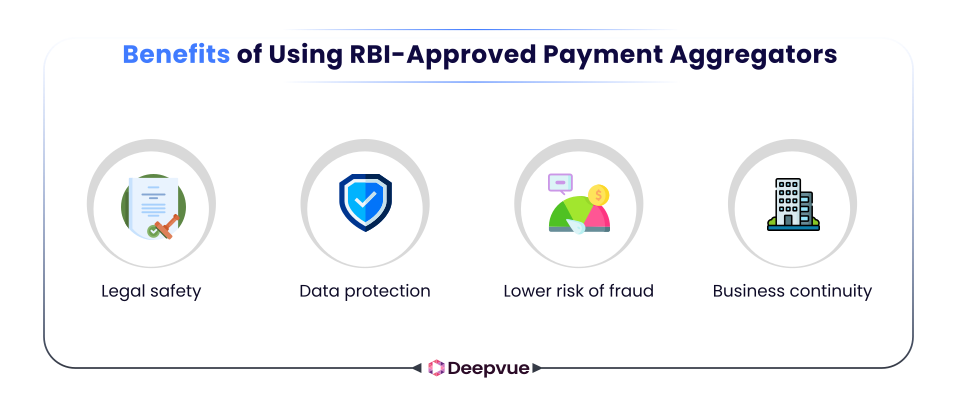
- Legal safety: Transactions are compliant with Indian laws.
- Data protection: Improved compliance with security procedures and PCI-DSS standards.
- Lower risk of fraud: Stricter supervision leads to lower chances of payment disputes.
- Business continuity: Merchants are not disrupted because of sudden regulatory crackdowns.
List of Payment Aggregators in India
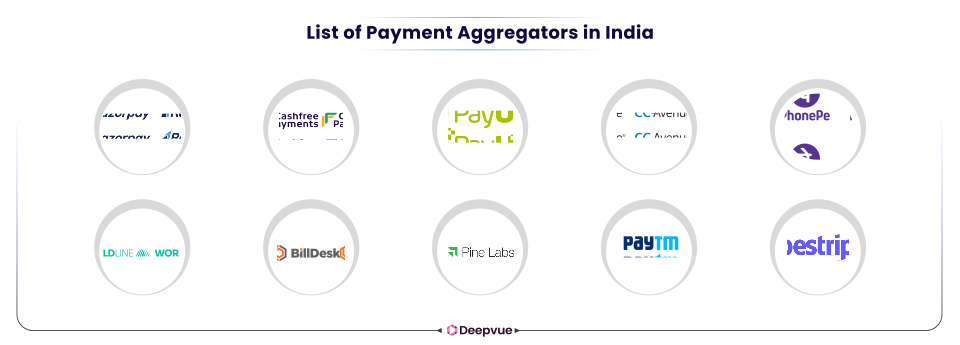
Note: Always cross-check the current status on the RBI official website for the latest information.
How to Choose the Right PA for Your Business?
Choosing a PA is not all about fees. It’s about long-term reliability, integration of technology, and compliance. These are the key considerations:
- Approval Status: Is the PA RBI-approved?
- Onboarding Time: How soon can you go live?
- Features: Subscription billing, payouts, reconciliation, and analytics.
- Support: Is the customer support timely?
- Pricing: Are fees competitive and clear?
Example Comparison:
- Razorpay is more developer-centric and has more properly written API documentation.
- PayU supports bigger merchants with better fraud protection features.
- Cashfree is best suited for bulk payouts and smooth integration with marketplaces.
Impact on Startups, D2C Brands, and Small Merchants
For small traders, particularly in Tier 2 and Tier 3 cities, having an unauthorized PA could be the difference between business as usual and mayhem. As the RBI strengthened its hold, several such enterprises had to realign with compliant counterparts.
D2C brands, which tend to be dependent on frictionless checkout experiences, also risk reputation if payments do not go through or refunds are late due to aggregator failures. Selecting the correct PA is no longer an internal backend decision; it directly impacts satisfaction of customer.
What’s Next: The Future of PA Regulations in India
RBI isn’t done yet. More stringent rules are expected, especially around:
- Real-time fraud detection mechanisms
- Multi-factor authentication
- Dynamic KYC refresh cycles
- Integration with Digital India Stack and DEPA (Data Empowerment & Protection Architecture)
India’s push towards a unified digital economy will mean tighter API governance, and possibly a national aggregator registry or real-time compliance dashboards.
Summary: What Merchants Should Take Away
RBI’s regulation of PAs is not just an administrative exercise; it’s a security net for the digital commerce ecosystem. If you’re a business owner, here’s your quick checklist:
- Only onboard RBI-approved PAs
- Stay updated with compliance developments
- Build redundancy by integrating with more than one PA
- Prioritize customer experience through trusted payment partners
Compliance today is your business continuity insurance for tomorrow.
FAQs
What is a Payment Aggregator (PA)?
A PA enables merchants to receive online payments from consumers through cards, UPI, or wallets without having to create a different bank account for each.
Why does RBI regulate PAs?
In order to facilitate safe, transparent, and compliant processing of electronic payments and safeguard customers’ interests.
Where do I see the updated list of approved PAs?
On the RBI website, in the section on Payment System Operators.
How does ‘in-principle’ differ from ‘final’ approval?
In-principle approval is conditional clearance, and final approval is full authorization for operation.
Am I allowed to use a non-RBI-approved PA?
Only if they were granted temporary approval before the cut-off, new merchant onboarding is prohibited for unapproved PAs.